
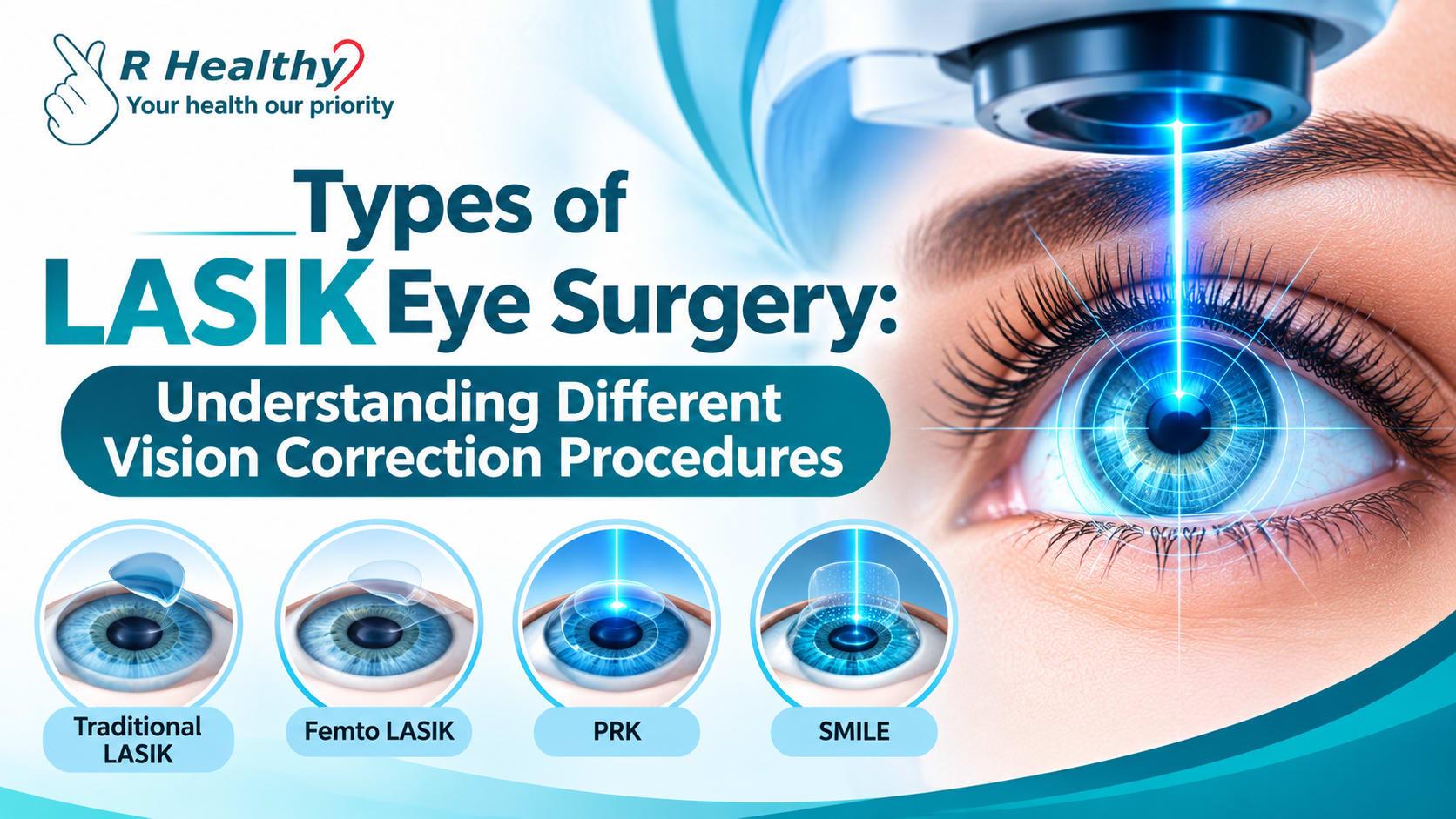
LASIK eye surgery is a common vision correction treatment that enables patients to rely less on glasses and contact lenses. This procedure utilizes laser technology to carefully resize the cornea and enable light to focus properly on the retina. Types of LASIK eye surgery is not a one-size-fits-all procedure; there are several techniques based on an individual's eye condition, lifestyle, and other visual needs.
Knowing the type of LASIK eye surgery you will get will be useful when talking about effective treatments with the best optometrist.
1. Traditional LASIK Surgery
LASIK is one of the most common Laser vision correction surgeries. It involves an operation in which the surgeon creates a thin hinged corneal flap, in order to be able to reshape the underlying tissue with an excimer laser.
For: Rated for some patients with nearsightedness, farsightedness, and astigmatism.
2. Femto LASIK Surgery
Femtosecond LASIK (also known as bladeless LASIK) involves making the corneal flap using a femtosecond laser rather than a metal blade. The excimer laser then reshapes the cornea and refines vision.
Key features:
Uses laser technology for flap creation.
Allows precise corneal flap formation.
Approved for some patients with simple refractive errors.
3. Contoura Vision LASIK
Contoura Vision is a topography-guided LASIK procedure that maps the cornea to determine how to best direct the laser eye treatment. It analyses the shape and the surface of the cornea to determine a unique treatment plan.
Key features:
Uses detailed corneal topography.
Provides customised corneal reshaping.
May be suitable for selected patients with myopia and astigmatism.
4. Wavefront-Guided LASIK
Wavefront-guided LASIK employs the latest diagnostic tools to identify irregularities in your eye's optical system. This allows the surgeon to create a personalised plan for laser correction.
Key features:
Evaluates individual optical imperfections.
Helps personalise vision correction.
May help address certain higher-order aberrations.
5. PRK (Photorefractive Keratectomy)
PRK is a surface laser vision correction that is an alternative to LASIK. It differs from LASIK in that it does not involve creating a corneal flap. PRK involves gently removing the cornea's outer epithelial layer before reshaping its surface using an excimer laser.
Some individuals with weaker corneas or individuals who may not be suitable candidates for flap-based surgery.
Recovery is typically longer than with LASIK, and patients may notice some soreness and discomfort during the first healing period.
6. SMILE (Small Incision Lenticule Extraction)
SMILE involves the use of a femtosecond laser to cut a small disc of tissue, known as a lenticule, within the cornea. The surgeon then extracts this lenticule through a tiny incision in the cornea to change its shape and improve vision.
Key features:
Lack of a large corneal flap.
Uses a small incision.
Mainly for the correction of myopia and some forms of astigmatism.
Which Type of LASIK Eye Surgery Is Suitable for You?
An eye exam is necessary in order to determine the most suitable vision correction procedure. The doctor considers the following before deciding:
Important considerations include:
Corneal Thickness: How thick and the shape of the cornea is also considered.
Eye Power: The strength of the myopia, hypermetropia or astigmatism determines the treatment choice.
Tear film health: Check for dry eye as part of pre-op testing.
Patients should be at a minimum age for sport to be dispensed, and the spectacle prescription should be stable.
The patient's eye health – existing eye diseases could make one a poor candidate for surgery.
Every vision correction procedure has specific eligibility criteria, so suitability varies from patient to patient. A LASIK eye surgery consultation will be performed to help determine what is safe and the best option.
Advantages of LASIK and Other Laser Vision Correction Treatments
Advantages of laser vision correction may include, based on the procedure performed and whether a patient is an appropriate candidate:
1. Decreased use of eyeglasses and contact lenses.
2. Improved unaided vision.
3. Quick visual recovery with certain procedures.
4. Personalised treatment options.
5. Greater convenience during everyday activities.
Nevertheless, these procedures also have possible side effects. Glare, dry eyes, halos, under-correction, over-correction, over correction and other visual effects are some of the side effects one can suffer from these procedures. The procedures differ from individual to individual.
What Is the Recovery Time After LASIK Eye Surgery?
Recovery varies depending on the type of procedure and how well the patient heals.
Traditional LASIK and Femto LASIK: Patients often notice immediate vision improvement within 24-48 hours.
The recovery is usually similar to other forms of LASIK.
PRK: Vision is slower to return and takes days to weeks, with continued improvement.
SMILE: Patients generally see some early visual improvements soon after the treatment, but stabilised vision may take a few days to come through.
Patients should obey their doctor's guidance, apply the eye drops as directed, refrain from rubbing their eyes, and check in on follow-up visits.
Conclusion
Read on to learn the various LASIK eye surgery types and which LASIK eye surgery is good for you. LASIK eye surgery types: Femto LASIK, Contoura Vision, Wavefront-Guided LASIK, traditional LASIK, PRK, and SMILE.
Before any procedure, a trained eye doctor should be consulted to have a thorough eye examination and personalise the surgery recommendation. Use the VR Healthy platform to discover eye information and patient care, and consult a healthcare professional for available vision correction options.